Goldwind's 1GWh Wind-Storage Project Enters Australia's EPBC Review Amid 56GWh NSW Target
Goldwind Capital has submitted its Milpulling wind-plus-storage Australia project for environmental assessment under the Commonwealth Environment Protection and Biodiversity Conservation (EPBC) Act, formally initiating the federal approval process for one of New South Wales' largest proposed hybrid renewable energy developments. The project—sited in the Central-West Orana Renewable Energy Zone (REZ) of NSW—pairs 600MW of wind generation capacity (up to 76 turbines with 10MW unit ratings and 300-meter tip heights) with a 250MW/1,000MWh DC-coupled battery energy storage system configured for 4-hour discharge, spanning approximately 11,670 hectares with a projected 35-year operational life.
NSW's 56GWh Storage Target: The Policy Engine Behind Milpulling
The Milpulling project enters the Australian development pipeline at a critical moment for New South Wales energy policy. The state government has recently increased its 2030 energy storage target from 40GWh to 56GWh—a 40% upward revision that reflects both the accelerating retirement of coal-fired generation and the growing recognition that storage, not just generation, is the binding constraint on renewable energy integration. However, as of March 2026, only 12.5GWh of storage had reached final investment decision in NSW, leaving a 43.5GWh gap that must be filled within approximately four years. The wind-plus-storage Australia pipeline—including Milpulling and dozens of competing projects—must rapidly accelerate from development to construction if the state's ambitious target is to be met.
DC-Coupled Architecture: Why Direct Coupling Matters
Milpulling's DC-coupled BESS architecture is a technically deliberate choice with significant operational and economic implications. Unlike AC-coupled systems—where the battery and wind generation connect independently to the grid—DC-coupled wind-plus-storage Australia configurations share power conversion equipment between generation and storage, enabling several advantages: reduced power electronics cost (one inverter serves both wind and battery), lower balance-of-system complexity, the ability to capture "clipped" wind energy that would otherwise be lost during periods when generation exceeds inverter capacity, and simplified grid interconnection through a single point of common coupling. For projects of Milpulling's scale—where every percentage point of efficiency and capital cost reduction compounds across a 35-year asset life—the DC-coupled architecture represents a meaningful competitive advantage in a market where project-level economics increasingly determine which developments advance from planning to construction.
AEMO's ISP Warning: Wind Deployment Lags Behind 82% Renewable Target
The timing of Goldwind's EPBC submission coincides with AEMO's release of the 2026 Integrated System Plan (ISP), which explicitly warns that Australian wind deployment is falling behind the trajectory required to meet the national 82% renewable energy target by 2030. The wind-plus-storage Australia hybrid model—pairing wind generation with DC-coupled storage—directly addresses one of the key barriers to wind deployment: revenue risk from negative pricing events during periods of high wind output. By coupling wind with storage, developers can shift generation from low-price periods (when wind output is high but demand is low) to high-price periods (evening peaks), improving project-level economics and reducing the investment risk that has slowed wind deployment relative to solar. For developers evaluating hybrid project configurations, explore our collection of DC-coupled BESS solutions designed for wind and solar hybridization.
The Central-West Orana REZ: Australia's Renewable Energy Powerhouse
The Central-West Orana REZ—where Milpulling will be sited—is emerging as one of Australia's premier renewable energy development zones, attracting billions in proposed investment across wind, solar, and storage projects. The NSW government's REZ framework provides coordinated transmission infrastructure planning—identifying network capacity, planning shared connection assets, and streamlining the connection process for multiple projects within the zone—addressing the interconnection bottleneck that has historically been the single largest barrier to Australian renewable energy deployment. For the wind-plus-storage Australia sector, the REZ model represents a critical enabling framework: by pre-building transmission capacity and creating standardized connection processes, REZs dramatically reduce the time and cost required to bring projects like Milpulling from environmental assessment to commercial operations.
76 Turbines at 300-Meter Tip Height: The Scale of Modern Wind
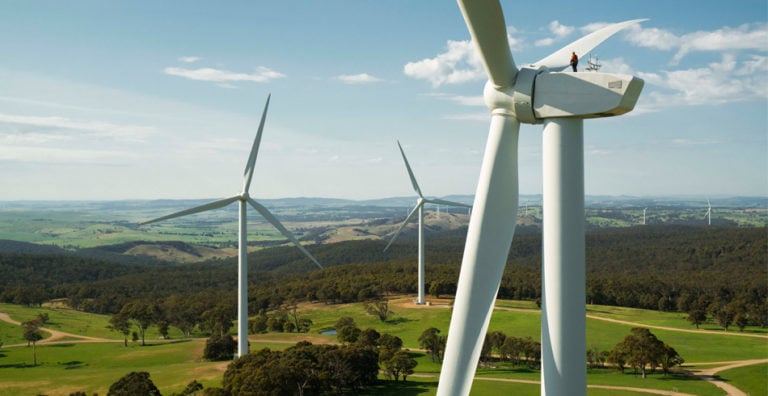
The Milpulling turbine specifications—up to 76 units with individual ratings of 10MW and tip heights reaching 300 meters—illustrate the extraordinary scale that modern onshore wind development has achieved. A single 10MW turbine at Milpulling will generate more electricity annually than entire wind farms did two decades ago, while 300-meter tip heights—taller than the Eiffel Tower—access stronger and more consistent wind resources at altitude. The wind-plus-storage Australia configuration at this scale means that Milpulling's annual generation will be measured in terawatt-hours, with the DC-coupled storage providing the firming necessary to convert variable wind output into dispatchable, grid-reliable electricity. For a state targeting 56GWh of storage by 2030, projects at Milpulling's scale—combining massive generation capacity with gigawatt-hour storage—are not optional additions to the pipeline but essential building blocks of the transition pathway.
The EPBC Process: Australia's Environmental Gateway
Submission under the EPBC Act represents the most significant federal regulatory milestone for Australian renewable energy projects, triggering a comprehensive environmental impact assessment that evaluates potential effects on matters of national environmental significance—including threatened species, ecological communities, and heritage sites. The wind-plus-storage Australia EPBC process typically takes 12-24 months from submission to approval, making it the critical path item on Milpulling's development timeline. For Goldwind Capital—the investment arm of Chinese wind turbine manufacturer Goldwind, one of the world's largest wind energy companies—navigating the EPBC process successfully is essential to demonstrating that international developers can deliver projects at scale within Australia's rigorous environmental regulatory framework. For international investors tracking Australian renewable energy opportunities, visit our store to discover AGAIC POWER's grid-compliant BESS platforms designed for Australian NEM requirements and REZ integration standards.
Australia's Storage Investment Gap: From 12.5GWh to 56GWh in Four Years
The wind-plus-storage Australia pipeline—with Milpulling as one of the largest entries—faces a daunting deployment challenge: bridging a 43.5GWh gap between committed storage capacity (12.5GWh) and the NSW 2030 target (56GWh) in approximately four years. This requires an average of nearly 11GWh of storage reaching final investment decision annually—a deployment rate that would make NSW one of the fastest storage buildouts in the world. The challenge is compounded by AEMO's warning that wind deployment in particular is lagging, creating a double urgency: accelerate storage and accelerate wind simultaneously, with hybrid projects like Milpulling providing the most efficient pathway to deliver both at once. For an industry that has repeatedly demonstrated its ability to exceed deployment expectations—Australian rooftop solar deployment consistently outperforms forecasts—the gap between policy ambition and project reality may prove narrower than current pipeline statistics suggest. But with coal retirements accelerating and the 2030 deadline approaching, the urgency is real, and projects like Milpulling will be watched as bellwethers of whether Australia's storage transition can deliver at the scale and pace that AEMO's modeling demands.