EU Ban on Chinese Inverters Reshapes BESS Supply Chains: Inside the Industry Response
The European Union's April 2026 decision to prohibit inverters manufactured in China, Russia, Iran, and North Korea from EU-funded solar and battery storage projects is already reshaping how battery energy storage system (BESS) integrators design their supply chains. Speaking exclusively to Energy-Storage.news at The Smarter E Europe conference in Munich, executives from Fluence and Rept Battero offered sharply contrasting perspectives on the EU Chinese inverter ban—one as a major Western integrator with multi-supplier flexibility, the other as a leading Chinese OEM navigating an increasingly fragmented global market.
The Ban's Architecture: What It Actually Covers
The EU Chinese inverter ban, effective from April 2026, restricts the use of inverters (and by extension, power conversion systems integrated into BESS units) from the four designated "high-risk" countries in any project receiving funding from major EU financial instruments, including the European Investment Bank (EIB) and European Investment Fund. The restriction mirrors the framework established by the US One, Big, Beautiful Bill Act (OBBBA), which similarly designates prohibited foreign entities tied to the same four nations. The ban followed a call from Members of the European Parliament (MEPs) in late 2025 to systematically restrict Chinese access to EU energy infrastructure—a policy trajectory that industry participants now view as irreversible and likely to expand in scope over time.
Fluence: Optionality as a Competitive Advantage
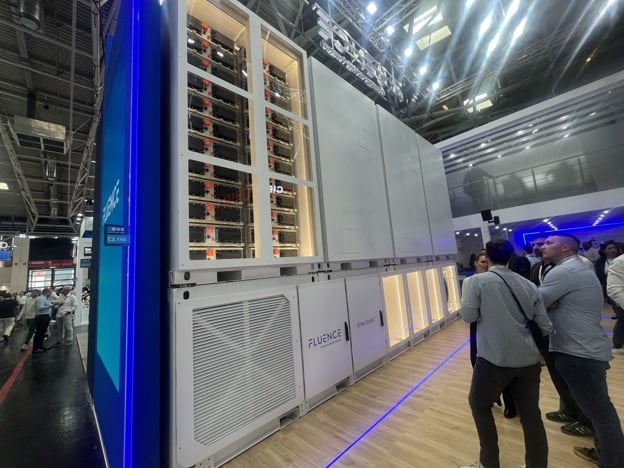
Lars Stephan, Fluence's Director of Marketing, Policy and Public Affairs for EMEA, characterized the ban as an accelerant for trends already underway within the company's supply chain strategy. Fluence—which unveiled its new 10MWh SmartStack BESS architecture at the same Munich conference—has deliberately designed its systems to support multi-vendor inverter sourcing, allowing the company to switch between suppliers based on regional regulatory requirements without redesigning the core platform. "The direction of travel is clear," Stephan indicated, noting that supply chain resiliency has evolved from a procurement preference to a regulatory compliance requirement—and that integrators who built optionality into their architectures early now hold a structural advantage over competitors tied to single-source inverter supply chains. For procurement teams evaluating BESS platforms for European deployment, explore our collection of compliant energy storage solutions designed for multi-market flexibility.
Rept Battero: Navigating the Fragmented Landscape
Andy Tang, CEO of Overseas Business for Chinese OEM Rept Battero, offered a more nuanced perspective. While acknowledging the challenges the ban creates for Chinese equipment exporters, Tang emphasized that Rept's diversified product portfolio—spanning cells, modules, and integrated systems—allows the company to participate in EU-funded projects through partnerships with non-Chinese inverter suppliers. More broadly, Tang argued that the global BESS market remains large enough to absorb supply chain fragmentation, noting strong demand from markets in the Middle East, Southeast Asia, and Latin America where procurement policies remain technology-neutral. The strategic question for Chinese OEMs, Tang suggested, is not whether they can sell into Europe—it is whether the margin compression from forced supply chain restructuring justifies the European market's complexity relative to faster-growing emerging markets.
The Broader Implications: From Inverters to Cells?
Industry participants in Munich raised a question that no policymaker has yet answered definitively: if the logic of the EU Chinese inverter ban is cybersecurity and supply chain sovereignty, does that logic not extend equally to battery cells—where Chinese manufacturers hold an even more dominant global market share? The current ban's scope is limited to inverters and PCS equipment, but the precedent it establishes could easily expand to cover cells, modules, or complete BESS enclosures in future regulatory rounds. Integrators with multi-source cell procurement strategies are already positioning for this scenario, while developers with single-source Chinese cell supply chains face growing project finance uncertainty in European markets. For asset owners seeking supply chain diversification, visit our store to learn how AGAIC POWER's flexible BESS configurations can reduce regulatory exposure.
CATL's Europe Strategy: "It's Very Complicated"
In a separate Q&A session at the same conference, CATL ESS EU President Amanda Xu was asked about the company's European market strategy in light of the inverter ban. Her frank assessment—"It's very complicated"—underscores the uncertainty facing even the largest Chinese battery manufacturers. Xu noted, however, that CATL's use of the prismatic form factor for both EV and BESS cells creates production flexibility that competitors using cylindrical or pouch formats cannot easily replicate, potentially allowing CATL to pivot production lines across applications as regional policies evolve. Whether that flexibility translates into durable European market access remains an open question—and one that will likely define the competitive landscape for years to come.
A New Era of Supply Chain Geopolitics
The EU and US bans on clean energy equipment from designated countries mark a fundamental shift in how the energy storage industry conceptualizes supply chain risk. For the past decade, the dominant procurement paradigm was cost optimization—sourcing cells, inverters, and balance-of-plant components from the lowest-cost global suppliers. That era is ending. In its place, a new paradigm of supply chain resiliency, regulatory compliance, and geopolitical optionality is emerging—one that favors integrators with multi-vendor architectures, diversified manufacturing footprints, and the legal and compliance infrastructure to navigate an increasingly complex global trade environment. The EU Chinese inverter ban may prove to be the first domino in a much larger restructuring of global clean energy supply chains.