CATL Sodium-Ion Energy Density Breakthroughs: How System-Level Advances Close the LFP Gap
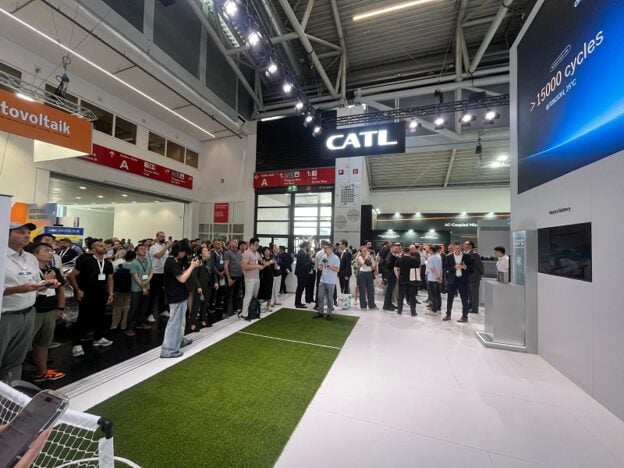
Contemporary Amperex Technology Limited (CATL) has revealed that its recent sodium-ion energy density improvements—enabling a 42-ton containerized system to deliver nearly 30MWh of storage capacity—were achieved primarily through system-level optimization rather than fundamental cell chemistry breakthroughs. Speaking to international trade media at The Smarter E Europe conference in Munich, CATL executives Amanda Xu (President of ESS EU) and Kevin Tang (Director of ESS Europe) detailed how the company's TENER sodium-ion BESS has reached an inflection point where sodium-based storage can credibly compete with lithium iron phosphate (LFP) on a total-cost-of-ownership basis.
System-Level vs. Cell-Level: Where the Real Gains Come From
Amanda Xu was candid about the nature of the improvements: the most significant sodium-ion energy density gains have materialized at the packaging and thermal management layer rather than within individual cells. While CATL has certainly advanced its cell technology over recent years—including refining cathode materials and optimizing electrode architecture—the company's engineers determined that decoupling power and energy capacity at the system level, combined with bidirectional voltage regulation for power conversion systems (PCS), unlocked far more deployable capacity per unit volume than incremental cell-level tweaks alone. This architectural insight is why the TENER sodium configuration can achieve roughly 3.75MWh per unit, compared to earlier sodium-ion designs that struggled to reach half the energy density of equivalent LFP containers.
The Modular Math: 34 Units, 1 Gigawatt
CATL's modular architecture deserves closer examination. The TENER sodium-ion BESS uses a standardized configuration of eight energy storage units paired with two cooling units to deliver just under 30MWh of capacity. Lithium-ion cells can be swapped into the identical physical enclosure—CATL calls this philosophy "One Shell, Two Cells"—which would increase capacity to approximately 50MWh in the same footprint. A full 1GW project requires just 34 connected sodium-ion units, a packing density that dramatically reduces land-use requirements, balance-of-plant costs, and construction timelines compared to earlier generations of sodium-based storage. For project developers evaluating next-generation storage technologies, explore our collection of flexible BESS solutions designed for utility-scale deployment.
The 30-Year Warranty Question
Perhaps the most ambitious claim CATL made in Munich concerns longevity: a 30-year warranty on the sodium-ion BESS product, matching the typical warranty duration of wind and solar generation assets. Amanda Xu explained that this warranty length was driven by "market demand for a lifetime which mirrored the warranty lengths on wind and solar"—a requirement that makes intrinsic sense for developers assembling project-financed portfolios where asset life must align across generation and storage components. CATL backs this promise with 300,000 validation cells already manufactured, a dedicated sodium-ion factory nearing commissioning, and a claimed 15,000 cycles at 25°C ambient temperature—equivalent to roughly 40 years of daily cycling. Procurement teams should note that warranty enforceability will ultimately depend on operational track records in the field, which CATL aims to build through initial Chinese deployments starting September 2026.
The Economics: Sodium Carbonate at 1% of Lithium Carbonate
Kevin Tang emphasized that the key to making sodium-ion energy density commercially viable lies in manufacturing scale and supply chain maturity rather than materials cost alone—though the materials advantage is substantial. Sodium carbonate, the primary raw material for sodium-ion cathodes, trades at approximately 1% of the price of lithium carbonate. Combined with sodium's geographic abundance (eliminating the concentrated supply chain risk that burdens lithium), the cost structure offers a structural hedge against the commodity price volatility that has repeatedly disrupted lithium-ion project economics. Tang noted that CATL has already established partner relationships capable of delivering "tens of thousands of tonnes of anode and cathode materials," positioning the company to scale production rapidly if demand accelerates—a scenario that appears increasingly likely given the 60GWh supply agreement already signed with system integrator HyperStrong.
Global Rollout: China September 2026, Worldwide June 2027
The commercial deployment timeline follows a deliberate two-phase approach. Initial sodium-ion TENER shipments begin in China in September 2026 under the HyperStrong agreement, targeting 1GWh in shipped units by year-end—a domestic proving ground that allows CATL to accumulate operational data before facing international scrutiny. Global shipments commence in June 2027, by which point CATL expects to have demonstrated consistent performance in real-world grid applications. As Amanda Xu acknowledged, international customers will "rightly ask fundamental questions about whether sodium-ion can scale and whether the systems can reliably operate over lifetimes of 20 years or more." For forward-looking developers planning multi-year technology roadmaps, visit our store to discover how AGAIC POWER's storage solutions can future-proof your project pipeline.
2026: The True Sodium-Ion Inflection Point
Taken together, the evidence presented at The Smarter E Europe points to 2026 as the genuine inflection point for sodium-ion energy density technology—and crucially, CATL executives were explicit that this is "not a short-term response to lithium carbonate price spikes." The combination of manufacturing readiness, validated cell supply, committed offtake agreements, and system-level engineering breakthroughs suggests that sodium-ion has crossed from laboratory promise to bankable commercial reality. The question is no longer whether the technology works, but whether it can operate reliably at scale over decades—and CATL is placing an enormous bet that the answer is yes.