Cambodia's 500MWh Grid-Forming BESS: ADB's $63 Million Push for ASEAN Grid Modernization
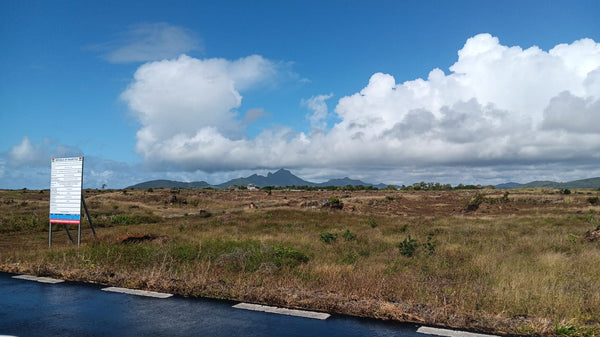
The Asian Development Bank (ADB) has approved a landmark $63.44 million financing package to support construction of a 250MW/500MWh grid-forming BESS Cambodia at the Takeo substation in southern Cambodia—one of the largest single battery storage investments in mainland Southeast Asia and a critical building block for the ASEAN Power Grid vision of integrated regional electricity trade. The project represents a new frontier for energy storage deployment: a developing economy using advanced grid-forming inverter technology to leapfrog traditional grid reinforcement approaches while enabling cross-border electricity trade with neighboring Vietnam.
The Multilayered Financing Architecture: ADB, GCF, and UK Government
The grid-forming BESS Cambodia financing package demonstrates the complex, multi-source funding structures that characterize development finance institution (DFI) energy projects in emerging markets. The $63.44 million total comprises four tranches: a $40 million concessional loan from ADB's ordinary capital resources, a $5 million grant from ADB-administered funds, $18.44 million in co-financing from the Green Climate Fund (GCF)—the world's largest climate fund—and additional co-financing from the UK government channeled through the ASEAN Catalytic Green Finance Facility (ACGF). This multilayered structure blends concessional and grant finance to reduce the effective cost of capital to levels that make the project economically viable in Cambodia's electricity market, where end-user tariffs remain among the lowest in Southeast Asia.
Grid-Forming Technology: Why It Matters for Emerging Grids
The designation of this project as grid-forming rather than grid-following is technically significant. Conventional grid-forming BESS Cambodia inverter systems operate as voltage sources rather than current sources—they can establish and maintain grid voltage and frequency independently, without requiring a strong external grid reference. This capability is especially valuable in developing-country grids characterized by weaker transmission infrastructure, higher renewable energy penetration variability, and limited synchronous generation from large thermal plants. The Takeo BESS will provide frequency control, voltage support, and synthetic inertia—services traditionally provided by the rotating mass of large thermal generators—enabling higher renewable energy penetration without compromising grid stability. The project will support industrial zones, agricultural processing facilities, and urban areas in southern Cambodia with reliable, high-quality electricity.
Cambodia's Storage Trajectory: From Zero to 1.5GWh in Two Projects
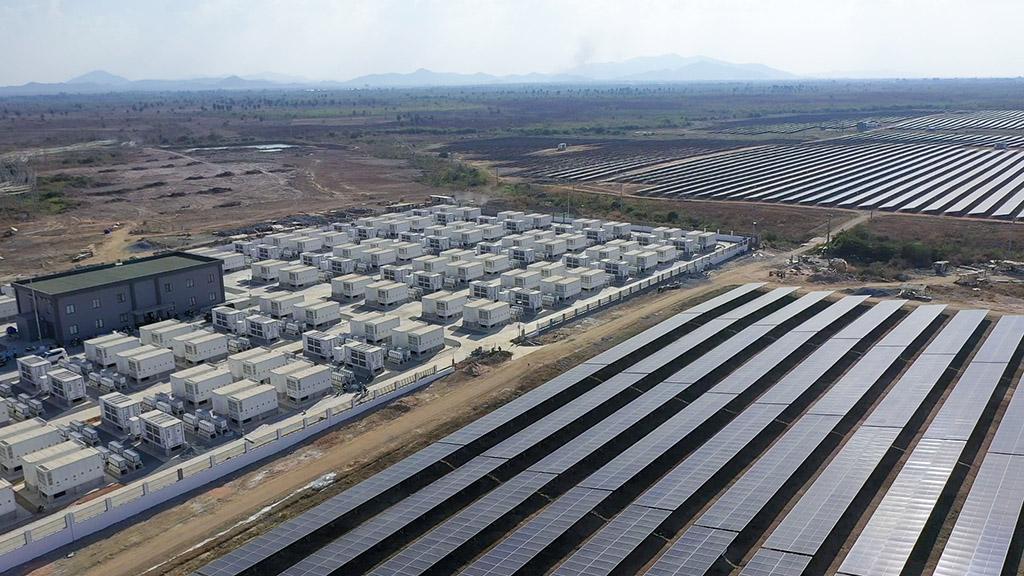
The Takeo project follows Cambodia's first utility-scale BESS—a 500MW/1,000MWh grid-forming installation in Pursat province in western Cambodia, which entered commercial operation in March 2026. Together, these two projects give Cambodia 750MW/1,500MWh of grid-forming BESS Cambodia capacity—a per-capita storage deployment that rivals many developed economies and positions the country as an unlikely leader in grid-forming battery technology within the ASEAN region. The Pursat project's successful commissioning provided the operational proof point that likely gave ADB and GCF confidence to proceed with the Takeo financing, demonstrating the virtuous cycle where initial DFI-supported deployments create the track record that enables follow-on investment. For developers targeting emerging Southeast Asian storage markets, explore our collection of BESS solutions engineered for tropical environments and developing-country grid conditions.
The ASEAN Power Grid: Cross-Border Trade as the Strategic Rationale
The grid-forming BESS Cambodia project's strategic rationale extends beyond domestic grid stabilization to the broader vision of ASEAN Power Grid integration. Cambodia shares a border with Vietnam, which operates one of Southeast Asia's largest and fastest-growing electricity systems, with significant seasonal and diurnal supply-demand imbalances. Grid-forming storage at Takeo—located in southern Cambodia near the Vietnamese border—enables bidirectional cross-border electricity trade by providing the frequency and voltage regulation necessary for stable interconnection between asynchronous grid regions. This aligns with the ASEAN Power Grid initiative, which envisions integrated regional electricity markets spanning all ten ASEAN member states, enabling the economic dispatch of renewable energy across national borders. The Takeo BESS is thus both a national grid asset and a regional market enabler—a dual role that strengthens its financing case with multilateral development banks.
Tender Requirements: 2GWh Track Record for Bidders
The project's tender documentation, open until August 20, 2026, requires bidders to demonstrate at least 2GWh of cumulative grid-connected or microgrid BESS project completion within the past five years—a qualification threshold that limits participation to established storage EPC contractors and system integrators with proven delivery track records. This requirement reflects lessons learned from earlier DFI-funded storage projects where inexperienced contractors struggled with commissioning and grid integration in developing-country contexts. The 2GWh threshold effectively creates a pre-qualified bidder pool of major international storage integrators, ensuring that the grid-forming BESS Cambodia project benefits from global best practices in BESS deployment, commissioning, and grid integration. For EPC contractors and integrators targeting DFI-funded storage opportunities in emerging markets, visit our store to discover AGAIC POWER's modular BESS platforms designed for rapid deployment in diverse grid environments.
What Cambodia's Storage Leadership Means for Emerging Market Electrification
Cambodia's emergence as a grid-forming storage leader—with 1.5GWh of BESS capacity across just two projects in a country of 17 million people—offers a compelling demonstration of how developing economies can use advanced storage technology to accelerate grid modernization without the decades-long infrastructure buildout that characterized electrification in developed markets. The grid-forming BESS Cambodia model—combining DFI concessional finance, climate fund co-financing, grid-forming inverter technology, and cross-border trade enablement—is replicable across dozens of developing economies facing similar challenges of weak grids, growing demand, and ambitious renewable energy targets. As the global energy transition increasingly focuses on emerging markets—where most future electricity demand growth will occur—Cambodia's experience with grid-forming storage may prove to be one of the most important demonstration cases for how to electrify the developing world with clean, reliable, and affordable power.